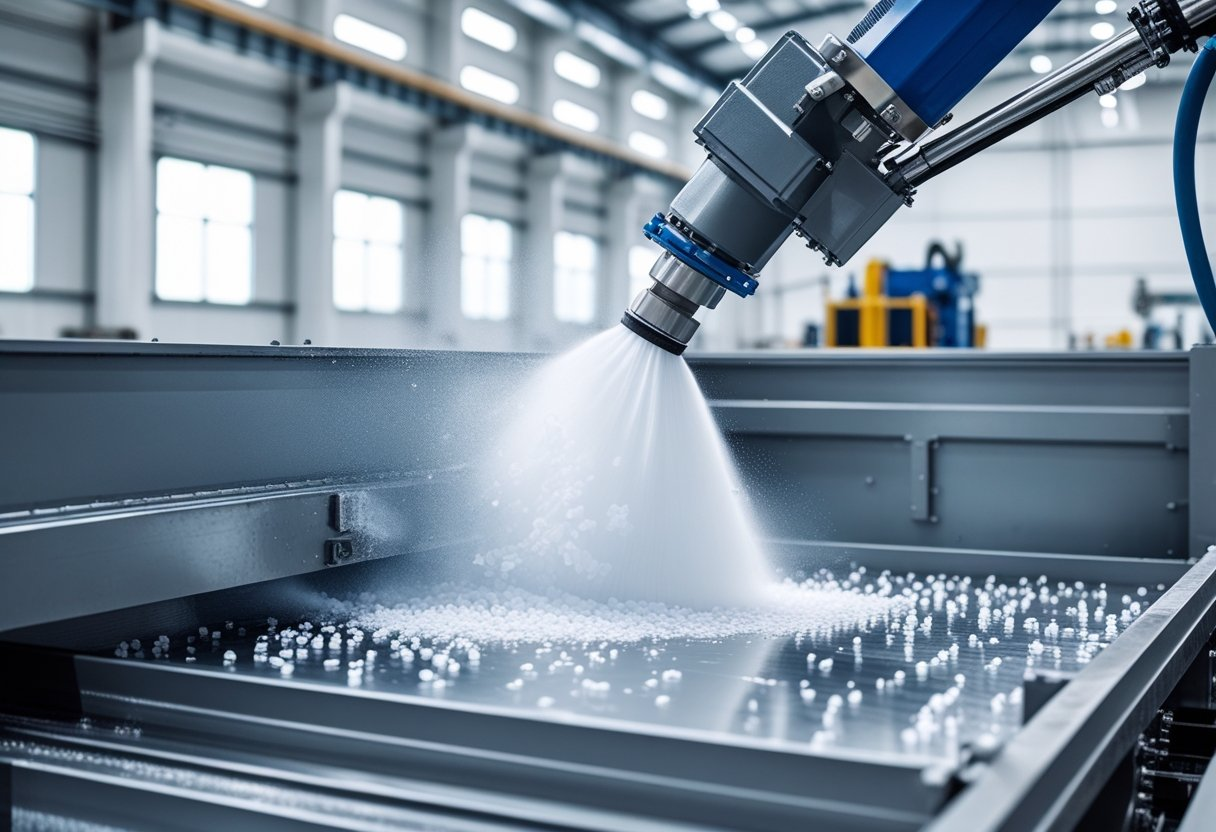
Industrial environments often grapple with challenges like residue buildup, equipment downtime, and the need to protect sensitive surfaces during cleaning operations. As a manufacturer of advanced dry ice blasting equipment, Nu-Ice Dry Ice Blasting offers a non-abrasive and eco-conscious solution that minimizes operational disruption. Unlike traditional cleaning methods involving water, harsh chemicals, or abrasive media, dry ice blasting preserves surface integrity while efficiently removing contaminants. When paired with KAESER™ air compressors—known for their reliable airflow, consistent PSI output, and mobile designs—air compressors for dry ice blasting enable operators to meet the rigorous demands of industrial cleaning jobs with enhanced precision and mobility.
Dry ice blasting is an industrial cleaning process that uses compressed air to accelerate dry ice pellets at high speeds toward a contaminated surface. These solid carbon dioxide (CO₂) pellets impact the surface and sublimate—transforming directly from a solid to a gas—on contact. This sublimation process lifts away unwanted materials without leaving behind any secondary waste like water or grit. Because it is non-abrasive, non-conductive, and free of chemicals, dry ice blasting is ideal for sensitive or complex equipment surfaces across manufacturing, food processing, and aerospace industries.
Kinetic Impact
Dry ice pellets are propelled at high velocity using compressed air. Upon contact, this kinetic energy loosens surface contaminants without damaging the underlying material.
Thermal Shock
The extreme cold of the dry ice creates a temperature differential when it hits warmer contaminants. This causes the bond between the residue and the surface to weaken, allowing easier removal.
Sublimation Expansion
As dry ice changes from solid to gas upon impact, it rapidly expands in volume. This expansion further disrupts and lifts contaminants, aiding in a thorough and dry clean without residue.
A dry ice blasting system consists of several integrated components. The air compressor supplies the high-pressure air needed to accelerate dry ice pellets. A dry ice hopper stores and feeds pellets into the system. The metering system controls the flow rate of dry ice, ensuring precision during operation. The hose and nozzle direct the air-and-pellet mixture toward the target surface. Each part works together to deliver a consistent, controlled cleaning process suited for industrial applications where surface preservation is key.
Nu-Ice Dry Ice Blasting is the U.S.-based manufacturer behind Nu-Ice Dry Ice Blasting systems. Founded in 1995, the company designs and builds its equipment entirely in the United States, emphasizing domestic production and engineering quality. Nu-Ice has focused on developing industrial cleaning solutions tailored for a wide range of industries, from power generation to aerospace. Its machines are used in facilities where abrasive or wet cleaning methods may pose challenges. As a result, KAESER™ air compressors are often paired with Nu-Ice systems to meet the airflow and pressure demands required for air compressors for dry ice blasting.
Nu-Ice dry ice blasting machines include several specialized components that support industrial-grade cleaning. The blasting gun is designed for ergonomic handling and is compatible with interchangeable nozzles to adapt to different surface geometries and cleaning intensities. This flexibility makes it suitable for both detailed and broad-area applications. The system also integrates a moisture separator and aftercooler, which work together to ensure that only dry, cooled air reaches the blasting chamber. The moisture separator removes excess humidity from the compressed air stream, while the aftercooler reduces air temperature to prevent premature sublimation of the dry ice. These features help maintain consistent blasting performance and reduce the risk of clogging during extended operations.
The Nu-Ice Commando 55 is a single-hose dry ice blasting machine built for industrial use. It measures approximately 40 inches long, 24 inches wide, and 40 inches high, offering a compact yet sturdy footprint. The machine weighs 285 pounds, allowing for stable mobility during operation. Its dry ice hopper has a capacity of 55 pounds, which supports extended blasting cycles before reloading is needed. The system operates efficiently within an air flow range of 90 to 250 CFM and can handle air pressure levels between 80 and 250 PSI. Typical dry ice consumption ranges from 1.2 to 2.8 pounds per minute, depending on settings and application needs. These specifications make the Commando 55 suitable for high-demand industrial cleaning environments.
Preparation and Setup
Before use, operators load dry ice pellets into the hopper and connect the unit to a compatible air compressor. All hose and nozzle attachments are checked for secure fitting.
Safety Requirements
Operators must wear appropriate personal protective equipment (PPE), including eye and hearing protection. The area should be ventilated to prevent buildup of CO₂ gas from sublimation.
Typical Workflow Steps
Once the system is powered and the airflow is adjusted, blasting begins by directing the nozzle at the target surface in sweeping motions. Flow rates and nozzle angles can be adjusted to accommodate different materials and surface complexities. After cleaning, residual ice sublimates without needing cleanup, and the system is safely shut down and depressurized.
Nu-Ice dry ice blasting systems are used across a wide range of sectors where residue buildup, contamination, and surface sensitivity present ongoing operational challenges. In manufacturing and production facilities, the systems are commonly applied to clean molds, presses, tooling, and conveyor systems without requiring disassembly or extended downtime. In food processing environments, dry ice blasting supports sanitation processes by removing buildup while avoiding moisture introduction that could affect hygiene controls or production schedules. The technology is also applied in historical restoration projects, where careful surface treatment is required to preserve aging materials, finishes, and structural details. Additional applications include cleaning engines, components, and assemblies in automotive and aerospace settings, where abrasive or liquid-based methods may pose risks to precision parts. Electrical components and control panels can also be treated due to the non-conductive nature of dry ice, making the process suitable for sensitive equipment. Specialty cleaning tasks such as fire damage restoration, adhesive removal, and surface preparation further demonstrate the versatility of this dry, non-abrasive method.
Dry ice blasting produces no secondary waste, as carbon dioxide pellets sublimate directly from a solid into gas upon impact. This characteristic eliminates the need for water recovery, chemical disposal, or abrasive media cleanup after cleaning operations. Because the process is non-abrasive, it is well suited for delicate machinery, coated surfaces, and equipment where maintaining surface integrity is critical. The absence of added moisture is particularly beneficial in electronics, food processing, and temperature-sensitive environments. As with any CO₂-based process, adequate ventilation is required to maintain air quality, and established handling and safety procedures should be followed. Operators using KAESER air compressors for dry ice blasting must ensure that airflow and pressure settings align with equipment specifications and operational guidelines.
Nu-Ice dry ice blasting equipment is compatible with a range of hose lengths and interchangeable nozzle configurations, allowing operators to adapt spray patterns for detailed or broad-area cleaning tasks. The systems are designed to integrate with air supply components such as aftercoolers and moisture separators to maintain consistent air quality and reduce the risk of premature pellet sublimation. For effective operation, dry ice pellets are typically stored in insulated containers to minimize loss prior to use. Routine maintenance procedures include purging lines after operation, inspecting seals and fittings, and ensuring hoses remain free of moisture or buildup to support consistent performance over time.
Frequently Asked Questions (FAQ)
What is dry ice blasting?
Dry ice blasting is a cleaning method that uses compressed air to accelerate dry ice pellets, which remove surface contaminants through impact and sublimation without leaving residue.
Is the equipment compatible with different air compressors?
Yes, Nu-Ice systems can be used with standard industrial air compressors, provided they meet airflow and PSI requirements specified for each blasting model.
What safety precautions are needed?
Operators should wear PPE, including goggles and ear protection, and ensure proper ventilation to avoid CO₂ gas accumulation during the sublimation process.
What infrastructure is needed to operate a dry ice blaster?
Basic infrastructure includes access to an air compressor, a supply of dry ice pellets, and adequate ventilation. Power sources and hose clearance are also needed.
How does it differ from abrasive blasting?
Unlike abrasive blasting, dry ice blasting does not use grit or sand and does not damage the substrate. It is a dry, non-abrasive, and residue-free process.
What are the environmental considerations?
Dry ice is made from reclaimed CO₂ and sublimates into gas, leaving no secondary waste. It eliminates the need for water or chemical cleaning agents.
Nu-Ice Dry Ice Blasting designs and manufactures industrial cleaning equipment intended for use in environments where precision, reliability, and surface protection are essential. All Nu-Ice systems are engineered and built in the United States, with a focus on durability, consistent performance, and compatibility with standard industrial air supply infrastructure. The company’s equipment is used across manufacturing, food processing, power generation, and specialty cleaning applications where traditional wet or abrasive methods may not be suitable. When operated in accordance with recommended airflow, pressure, and safety guidelines, Nu-Ice dry ice blasting systems provide a controlled, dry cleaning process that supports routine maintenance and operational continuity. By integrating established compressed air technologies and maintaining a straightforward, serviceable system design, Nu-Ice equipment is positioned to support industrial cleaning tasks that require minimal disruption and careful handling of sensitive surfaces.
About Post Author